A Full Restaurant Does Not Necessarily Mean a Profitable Restaurant
One of the main considerations for entrepreneurs planning to open a restaurant is the initial investment. Budgets are usually prepared for renovation, kitchen equipment, furniture, interior design, staffing, and marketing. However, a more important question often remains unanswered:
How much revenue must a restaurant generate each month to cover all its operating costs?
To answer this question, you need to calculate the break-even point.
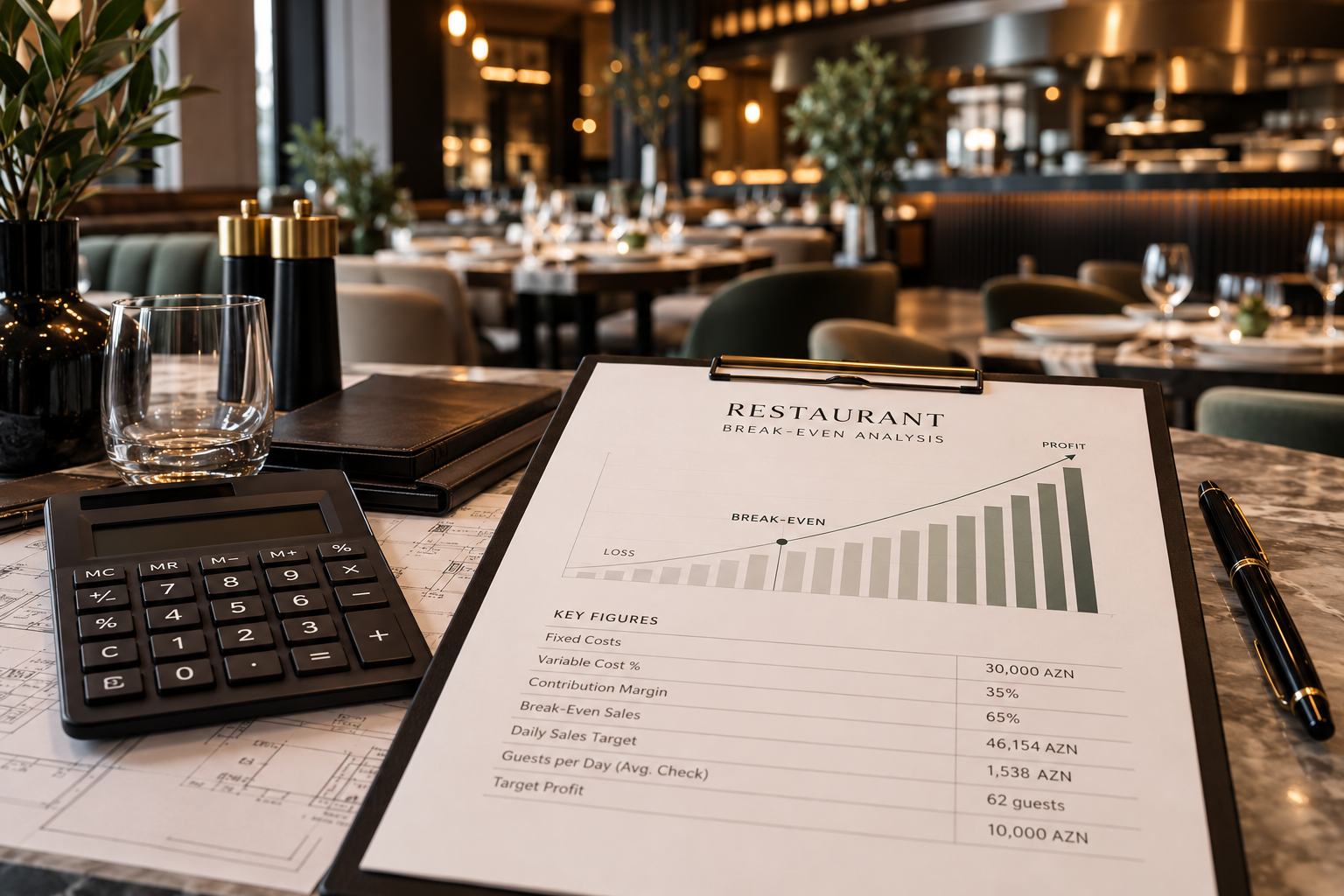
The Break-Even Point (BEP) is the level at which a business’s total revenue equals its total costs. At this point, the restaurant makes neither a profit nor a loss.
Calculating this figure before opening helps business owners establish realistic sales targets, assess investment risks, and plan for long-term financial sustainability.
1. Separate Fixed and Variable Costs
The first step in effective financial planning is to divide expenses into two main categories.
Fixed Costs
Fixed costs are expenses that generally remain stable over a given period, regardless of sales volume.
In a restaurant, these may include:
* Rent;
* Administrative staff salaries;
* Accounting and software subscriptions;
* Fixed service fees;
* Insurance and other contractual payments.
Some labor costs may vary with sales. For example, sales-based bonuses should be accounted for separately from fixed payroll expenses.
Variable Costs
Variable costs change in relation to sales volume.
Common examples include:
* Food and beverage ingredient costs;
* Sales-related packaging expenses;
* Delivery platform commissions;
* Other sales-dependent charges.
Correctly classifying these expenses is essential. Otherwise, the calculated break-even point may not accurately reflect the restaurant’s financial position.
2. How to Calculate the Break-Even Point
The break-even point in sales revenue can be calculated using the following formula:
Break-Even Sales = Fixed Costs ÷ Contribution Margin Ratio
The contribution margin is the amount remaining after variable costs are deducted from sales revenue. It contributes toward covering fixed costs and generating profit.
The formula is:
Contribution Margin Ratio (%) = (Sales Revenue − Variable Costs) ÷ Sales Revenue × 100
Practical Example
Suppose a new restaurant has the following monthly financial figures:
Metric Amount
Monthly fixed costs AZN 30,000
Variable cost ratio 35%
Contribution margin ratio 65%
The break-even point is calculated as follows:
AZN 30,000 ÷ 0.65 = AZN 46,154
This means the restaurant must generate approximately AZN 46,154 in monthly sales to cover the costs included in this simplified model, assuming the other factors remain unchanged.
This figure is not a profit target. It represents the restaurant’s break-even sales level.
For an accurate calculation, all figures must follow consistent accounting principles. VAT and other relevant taxes must also be treated consistently when calculating revenue and costs.
3. Establish a Daily Sales Target
Knowing the monthly break-even point is not enough. Restaurant managers and operations teams also need a daily sales target.
In the example above, the monthly break-even point is AZN 46,154.
If the restaurant operates 30 days per month:
AZN 46,154 ÷ 30 = AZN 1,538 in daily sales
This represents the average daily revenue required to break even. However, sales are rarely consistent every day. Weekends, public holidays, seasonality, and location can all influence demand.
A more effective approach is to allocate sales targets across different days and periods.
For example, if higher sales are expected on weekends, weekday targets should be planned separately. The overall monthly target must remain realistic and aligned with expected guest traffic and the restaurant’s service capacity.
4. Plan Sales Based on Guest Count and Average Check
To turn a sales target into an operational plan, calculate the required guest count using the average check.
Suppose the restaurant’s average check is AZN 25.
With a daily break-even sales target of AZN 1,538:
AZN 1,538 ÷ AZN 25 ≈ 62 guests per day
Therefore, the restaurant would need to serve approximately 62 guests per day to reach its break-even sales target, assuming the average check remains stable.
This is an illustrative calculation. Actual planning should account for discounts, cancellations, taxes, sales channels, and differences in customer spending.
If the restaurant’s realistic capacity is only 40–45 guests per day, a target of 62 guests may not be achievable. In this case, the owner should reassess the business model.
Potential actions include:
* Increasing the average check by offering relevant additional value;
* Reviewing menu profitability;
* Optimizing operating expenses;
* Attracting additional guests through marketing;
* Reassessing operating hours and the service model.
The objective is not simply to serve more guests, but to create a financially sustainable operation.
5. Calculate Your Profit Target in Advance
The break-even point indicates the sales level required to cover costs. However, most business owners aim to generate a profit.
Suppose the restaurant targets AZN 10,000 in monthly operating profit.
With fixed costs of AZN 30,000 and a contribution margin ratio of 65%, the required sales revenue is calculated as follows:
Required Sales = (Fixed Costs + Target Operating Profit) ÷ Contribution Margin Ratio
(AZN 30,000 + AZN 10,000) ÷ 0.65 = AZN 61,538
Under this simplified model, the restaurant must generate approximately AZN 61,538 in monthly sales to achieve its AZN 10,000 operating profit target.
This calculation does not automatically account for every financial item. Interest, depreciation, income tax, and other excluded expenses may affect the final result, depending on how operating profit is defined.
6. Common Financial Planning Mistakes
Several mistakes can distort a restaurant’s break-even calculation.
1. Overlooking Expenses
In addition to rent and salaries, the financial model should include utilities, maintenance, software, cleaning, marketing, and other operating expenses.
2. Confusing Revenue with Profit
High turnover does not automatically mean high profitability. Owners must understand how much of their sales revenue remains after costs are deducted.
3. Ignoring Seasonality
Summer and winter trading patterns, holidays, and tourism demand can significantly affect restaurant sales.
4. Relying Only on an Optimistic Scenario
It is useful to prepare at least three financial scenarios:
* Optimistic: Sales exceed expectations.
* Realistic: Sales align with the main business plan.
* Pessimistic: Sales fall below the forecast.
Scenario planning helps owners understand how the business might perform under different conditions and identify potential funding gaps.
5. Treating Revenue as Cash Flow
A restaurant may appear profitable but still experience cash shortages due to supplier payments, payroll, tax obligations, or loan repayments.
For this reason, break-even analysis should be supported by working capital planning and a cash flow forecast.
7. Questions to Answer Before Opening a Restaurant
Before making an investment decision, consider the following questions:
* What are the restaurant’s total monthly fixed costs?
* What percentage of sales is consumed by variable costs?
* How many guests must the restaurant serve daily to break even?
* Is the projected average check realistic for the target market?
* Can the restaurant’s seating capacity and operating hours support the required sales volume?
* If sales are 20% below forecast, how long can the business continue operating?
* Is there enough reserve capital to cover operating expenses after opening?
Answering these questions helps evaluate not only the initial investment but also the restaurant’s financial resilience once operations begin.
Conclusion: Successful Restaurants Are Managed Through Numbers
Success in the restaurant industry depends on more than a strong concept, quality food, and excellent service. Financial discipline and realistic planning are equally important.
Accurately calculating the break-even point helps business owners establish sales targets, control expenses, and assess investment risks more effectively.
At NBProjects, we believe every hospitality project should be built on a sound financial model supported by market research, alongside concept development, design, and operational planning.
Because a restaurant’s success is measured not only by how much it sells, but also by how sustainably and profitably it operates.
NBProjects — Hospitality • Consulting • Development
← Journal